
Products

Aluminum bronze - the high-end copper alloy
Lead-free aluminum bronzes offer ideal properties
Many industries already benefit from the excellent sliding properties of ALBROMET aluminum bronzes. In general, aluminum bronzes combine very good, steel-like strength values with high corrosion resistance to water, seawater, acids and chemicals. ALBROMET offers a wide range of aluminum bronzes with hardness values of 190 – 310 HB and a modulus of elasticity of 110 – 127 kN/mm2. This makes them the ideal materials for sliding elements such as plain bearings, guide bushes, sliding plates or pins.
Even if the name suggests otherwise, aluminum bronzes are copper alloys. They contain aluminum as the main alloying element, usually in the range of 5 – 15%. This main alloying element gives them their name. Aluminum bronzes can contain other alloying elements such as iron, nickel, manganese or zinc in lower percentages in order to improve certain properties. All ALBROMET aluminum bronzes are lead-free and comply with the requirements of the REACH and RoHS regulations.
ALBROMET aluminum bronzes, properties and characteristic values:
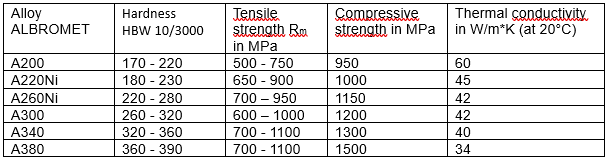
You can find all characteristic values here:
We supply aluminum bronzes as semi-finished products according to your wishes and shape
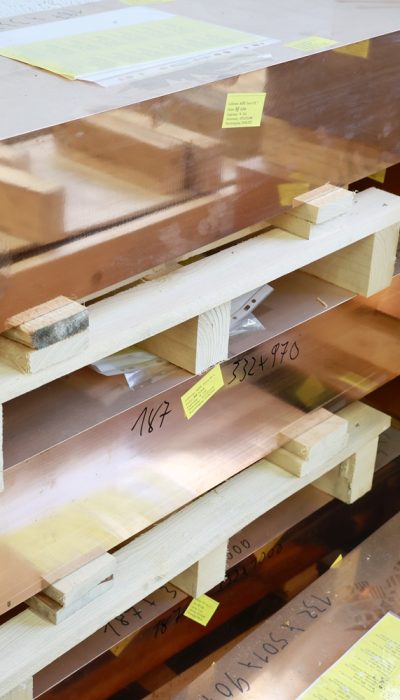
The aluminum bronzes are available in stock as cast, pressed or forged semi-finished products in various shapes (round, tube, plate) and dimensions. Convince yourself of our comprehensive product range.
ALBROMET supplies semi-finished products tailored to your desired dimensions. At the same time, thanks to our extensive CNC machinery, we can also produce finished parts from all the aluminium bronzes mentioned above according to your drawings from a quantity of 1. This helps to relieve your production and minimize procurement costs. Please ask for a non-binding offer!
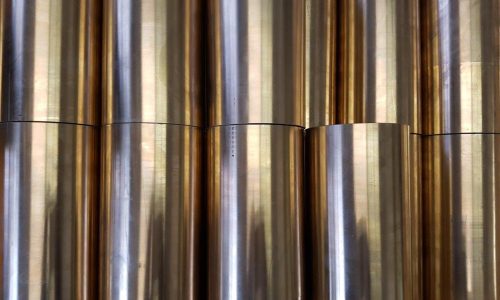
Aluminum bronze has particularly good corrosion resistance
Aluminum bronzes are characterized by excellent corrosion resistance, which is based on the spontaneous formation of a dense aluminum oxide layer (Al₂O₃) on the surface. This passivating protective layer regenerates itself in the event of damage and reliably protects the material from attack by oxygen, salt water and many acids. Aluminum bronzes are particularly suitable for maritime applications, as they withstand the aggressive influence of seawater, current erosion and biogenic fouling much better than many other copper alloys. They are also highly resistant to non-oxidizing acids and organic compounds, which makes them attractive for use in the chemical and petrochemical industries.
The corrosion resistance can be further increased through targeted alloying with nickel, so that aluminum bronzes offer a long service life and low maintenance requirements even under extreme operating conditions. Alloys with an increased nickel content such as ALBROMET-A220Ni and ALBROMET-A260Ni offer very good resistance to cavitation due to their higher toughness.
Aluminium bronzes are the best alternative to standard brass alloys if intercrystalline corrosion or dezincification is to be expected during use.
Aluminum bronzes with food certificate
The following ALBROMET aluminum bronzes and guide bushings have been declared safe for direct contact with food by an independent testing institute in accordance with EU Regulation 1935/2004. These alloys are therefore ideal for use in the food technology and packaging industry and combine very high wear resistance with good thermal conductivity.

Answers to frequently asked questions
The “A” stands for aluminum bronze, and the number that follows represents the average hardness value measured in Brinell (HBW10/3000).
ALBROMET aluminum bronzes do not contain any hazardous substances that are on the REACH candidate list (SVHC list). The average lead content is < 0.02%, which is well below the critical value of < 0.05%. This means that the copper alloys are REACH and RoHS compliant. You can find more information here.
Due to its composition and excellent polishability, aluminum bronze reduces sliding friction between mating surfaces. Aluminum bronze and steel do not react chemically with each other and therefore do not form any compounds that could lead to adhesion. Their high hardness and strength also make them resistant to abrasion. If the hardness of the selected aluminum bronze is lower than that of the friction partner (e.g., steel), it is defined as the wear partner in the friction system. Aluminum bronze efficiently dissipates heat, which prevents the sliding surfaces from overheating. By dissipating heat, this also reduces the likelihood of damage caused by thermal stress during sliding friction between the sliding surfaces. Sufficient lubrication is required depending on the load. However, the emergency running properties of aluminum bronze are very good.
Aluminum bronzes are usually produced using traditional smelting processes and further processing of continuous cast billets in forges and pressing plants. ALBROMET sources its aluminum bronzes mainly in Europe and North America. Various dimensions of round, tubular and flat material are kept in stock. These are cut to size at ALBROMET at short notice.
Aluminum bronzes are generally highly recyclable, as copper and its alloys are among the most commonly recycled metals worldwide and can be remelted with virtually no loss of material. The recycling process requires significantly less energy than primary production, which substantially reduces the environmental footprint of aluminum bronze components over their entire life cycle. One challenge in recycling is the accurate sorting and identification of the various alloy types, as different aluminum bronzes contain varying levels of aluminum, nickel, iron, and manganese, which require specific processing. However, modern analytical techniques such as X-ray fluorescence analysis (XRF) enable rapid and precise alloy identification in the scrap metal trade, thereby ensuring that materials are sorted by type and recycled to a high standard. Since there is virtually no loss of quality when melting down aluminum bronze scrap, recycled alloys can in many cases be used directly in demanding technical applications such as plain bearings, guide bushings, and forming tools.
Aluminum bronzes are corrosion-resistant in alkaline media with a pH value of > 7. They are often used in applications involving alkaline solutions or alkaline media, such as in the chemical industry, in seawater environments or in applications with a high pH value. The addition of aluminum to copper alloys forms a protective oxide layer on their surface, which protects them from corrosion. This oxide layer is particularly stable and resistant, even in basic or alkaline environments. However, the resistance depends on the specific composition of the alloy, the temperature, the concentration of the basic solution and the duration of exposure.
In acidic media with a pH value between 7 and 4.5, aluminum bronzes exhibit good corrosion resistance.However, they can be sensitive to strong or oxidizing acids such as hydrochloric acid or sulphuric acid.The concentration of the acid plays an important role here.Higher temperatures increase reactivity and accelerate corrosion.The exact composition of the aluminum bronze alloy influences its corrosion resistance.
Aluminum bronzes have a high strength, which makes them robust and resistant to mechanical stress. Carbide tools are very suitable for machining aluminum bronzes. Diamond tools offer the best performance, especially for demanding machining operations. High-speed steel (HSS) tools can be used, but are less effective than carbide or diamond tools. Adequate cooling and lubrication during machining is essential. This helps to keep the tools cool, improve surface quality and extend tool life. With the right techniques and tools, precise and high-quality machining results can be achieved.
Get in touch with us!
We will advise you competently and personally.


