
Products
Copper alloys from ALBROMET - conductive and high-strength

Low-alloy copper alloys - a highly developed material
ALBROMET offers a wide range of highly conductive copper alloys. Thanks to alloying elements such as nickel, cobalt, silicon, beryllium, and chromium, these alloys possess unique combinations of properties that are highly valued in many applications. The materials are heat-treated and combine very good electrical and thermal conductivity with excellent mechanical properties and good corrosion resistance. All ALBROMET copper alloys are lead-free and comply with the requirements of the REACH and RoHS regulations.
These alloys are primarily used in plastic molding, metal forming, the steel industry, or as electrode materials for resistance welding, where very high thermal conductivity and electrical conductivity are key requirements.
The compressive strength and modulus of elasticity (135–140 GPa) of these copper alloys are comparatively high compared to brass (100 GPa) or stainless steels (200 GPa). At the same time, its thermal conductivity—ranging from 130 to 260 W/m*K (at 20°C)—is up to 12 times higher than that of stainless steel. Their excellent resistance to various media also makes them ideal for use as sealing rings.
Properties and characteristic values of ALBROMET copper alloys

You can find all the technical specifications in the data sheets:
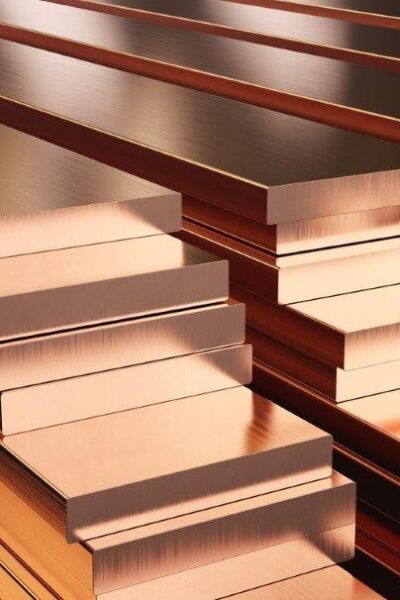
Copper alloys are held in stock as cast, extruded or forged semi-finished products in a wide variety of shapes (round bars, tubes, plates) and dimensions. See for yourself our comprehensive range of products. At our in-house sawing centre, we can cut the semi-finished products to your specifications at short notice.
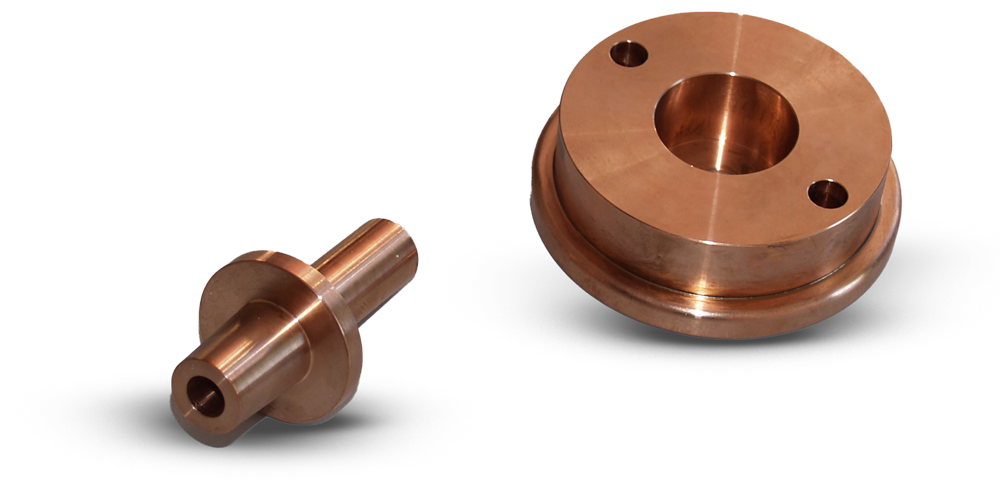
At the same time, thanks to our extensive range of CNC machinery, we also produce finished parts from all the copper alloys mentioned, based on your drawings, from as little as one piece. This helps to take the pressure off your production and minimise your procurement costs.
Please email us to request a no-obligation quote at fertigteile@albromet.de!
Beryllium-free copper alloys
The ALBROMET-W164 and ALBROMET-W200 alloys are two beryllium-free copper alloys in the ALBROMET product range that offer very high thermal conductivity combined with excellent strength properties and, consequently, wear resistance.
With tensile strengths of up to 860 MPa, these alloys achieve values similar to those of beryllium-containing alloys and, thanks to their excellent thermal and electrical conductivity, have been developed as a replacement for copper-beryllium alloys in high-end applications.
Why are beryllium-free alloys interesting?
Safety precautions must be observed when machining or welding beryllium-containing alloys. These measures include specialised ventilation systems, personal protective equipment and regular health checks for workers. For this reason, beryllium-free copper alloys are preferred as alternative materials wherever possible. However, there are no restrictions on the use of machined components made from beryllium-containing alloys.
Beryllium is not on the list of hazardous substances according to REACH.
Copper alloys with food certification
ALBROMET has received a declaration of no objection from an independent testing institute for the following copper alloy for use in direct contact with foodstuffs in accordance with EU Regulation 1935/2004. This alloy is therefore also ideal for use in the food technology and packaging industry and combines high wear resistance with very good thermal conductivity.

Answers to frequently asked questions
For copper alloys, the number after the “W” stands for the thermal conductivity at 20° C in W/m*K.
Thermal conductivity in copper alloys describes how well a material can conduct heat – in other words, how quickly temperature differences within the material are equalised. It is particularly important for applications such as plastic moulding, power electronics and cooling components. It is particularly important for applications such as plastic moulding, power electronics and cooling components. It is usually measured using the physical quantity λ (lambda) in W/(m·K), which indicates how much heat flows through one metre of material at a given temperature difference. Pure copper has very high values, whilst alloying elements generally reduce thermal conductivity as they increase electron scattering. In practice, the assessment is often carried out indirectly via electrical conductivity (e.g. in %IACS), as both properties are closely linked.
The terms conductive copper or highly conductive copper alloy describe the property of being able to conduct heat or electricity very well. These properties are used particularly in plastic mould construction and extrusion technology, as mould inserts and mould cores to optimize cycle times and product quality, as well as in numerous other components such as nozzles and blow moulds. These alloys are also used as welding mirrors, tempering elements and electrodes in resistance welding and in mechanical engineering as a whole.
The high-temperature resistance of these alloys is not due to high alloy content, but rather to a specifically engineered, thermally stable precipitation microstructure. Whilst pure copper loses a significant amount of its strength even at comparatively low temperatures of around 100°C, low-alloy copper alloys such as W164, W200 and W240 retain their mechanical properties even under thermal stress of up to 480°C. After solution heat treatment and subsequent aging, very fine precipitates form in the copper structure of these alloys. These act as effective obstacles to plastic deformation, resulting in high strength values. As these precipitates only grow slowly, even at elevated temperatures of up to 480°C, the hardness and mechanical strength remain stable over a wide temperature range. This is why these alloys are also preferred in applications where high electrical conductivity, wear resistance and thermal stability are required at the same time – for example in resistance welding technology, electrical contacts or in sophisticated electromobility components.
Copper alloys are generally non-magnetic. Pure copper is a non-magnetic metal. If copper is alloyed with other metals, such as with zinc to produce brass or with tin to produce bronze, the alloy also remains non-magnetic in most cases. This is because the added metals are also non-magnetic.
However, some special copper alloys can have magnetic properties if they contain iron or nickel. These metals are ferromagnetic and can influence the magnetic properties of the alloy.
ALBROMET copper alloys are therefore largely non-magnetic, which has advantages in many applications. Chips and metallic dust do not stick. In addition, there is usually no sparking.
Resistance welding is a process in which electrical currents flow through the parts to be joined in order to generate heat and melt and join the material at the joint. Copper and its alloys possess excellent electrical and thermal conductivity. These properties enable efficient heat transfer to the weld zone, which promotes the formation of a strong and reliable welded joint. For this reason, low-alloy copper alloys are very well suited to resistance welding due to their excellent electrical and thermal conductivity, as well as their wear resistance.
ALBROMET copper alloys do not contain any hazardous substances on the REACH candidate list (SVHC list). The lead content is minimal (< 0.1 percent by mass). This means that the copper alloys are REACH and RoHS compliant. You can find more information here.
Copper alloys are usually produced using traditional smelting processes and further processing of continuous cast billets in forges and press shops. ALBROMET sources the copper alloys mainly in Europe and North America. The ALBROMET warehouse stocks a wide variety of dimensions of round material and sheets, which can be cut to size at short notice.
Get in touch with us!
We will advise you competently and personally.


