
Products
Copper beryllium - High copper alloy with maximum strength

Beryllium copper - valued in many industries
Beryllium copper, also known as copper beryllium or beryllium bronze, is a copper-based alloy with 0.4 to 2 % beryllium. The ALBROMET product range includes semi-finished or finished parts made from the most important high-strength alloys CuBe2 (ALBROMET W-130) and CuCoBe (ALBROMET-W240).
The highly conductive alloy ALBROMET-W240 has a lower beryllium content of 0.3 – 0.5 %. This is mainly supplied and processed in a factory-tempered condition. Subsequent curing after processing is not necessary.
The high-strength, hardened alloy ALBROMET-W130 with approx. 2.0 % beryllium content achieves the highest strength and hardness of all copper alloys. The tensile strength can reach up to Rm = 1300 MPa and a hardness of 42 HRC. The mechanical strength values are therefore comparable to those of many steel alloys. When it comes to a combination of corrosion resistance, thermal conductivity and electrical conductivity, beryllium copper is actually significantly superior to steel.
The fact that beryllium copper is non-sparking makes it a suitable choice for use in potentially explosive atmospheres, such as in the oil and gas industry, the chemical industry and in mining.
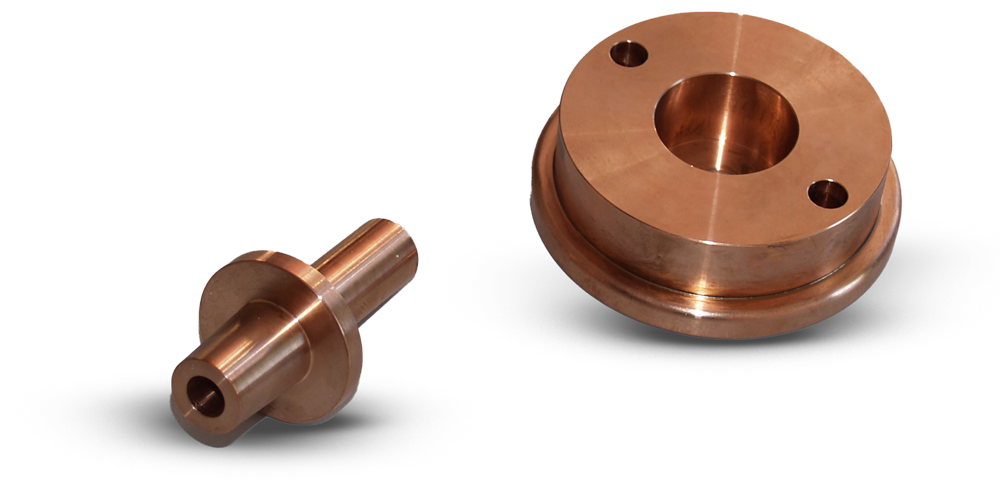
Special properties of beryllium copper:
- Excellent electrical conductivity and thermal conductivity
- Not magnetic
- High corrosion resistance
- High wear and fatigue resistance
- Good machinability and formability in the uncured state
- Spark-free
- Very low risk of hydrogen embrittlement and stress corrosion cracking (SCC)
Areas of application:
- Injection molds in plastics technology
- Electrodes and electrode holders for resistance welding
- Valve seat inserts in engine construction
- Sealing rings in mechanical engineering
- Highly loaded springs in machines
- Dies for forging metals and deep-drawing metals
- Non-sparking tools
- Contact springs in relays
Important notes on processing beryllium copper:
The handling of materials containing beryllium may pose a health risk if safe working practices are not followed, particularly in processes that generate dust or fumes. Inhalation of beryllium-containing dust, mist or smoke can lead to serious lung diseases in some people. The degree of danger varies depending on the shape of the product and the processing and treatment of the material.
Read the safety data sheet with the relevant health, safety and environmental information before working with materials containing beryllium. It specifies suitable protective measures for the relevant work steps. The use of components made from copper-beryllium alloys in their solid state does not pose any particular health risks.
Handling, sawing, shaping, most machining operations (turning, milling), brushing, surface coating, thermal treatments are operations with a low risk of inhalation and do not require special precautions. Particular attention is paid to the processes of melting, casting, welding, forging, grinding, polishing, oxy-fuel cutting, soldering, brazing, blasting and electrical discharge machining, where dust and fumes are generated during machining. In these cases, suitable extraction and filtering equipment should be used so that the concentration of 0.6 micrograms of beryllium per cubic meter of air (µg/m3 ) (inhalable), measured as an 8-hour time-weighted average (TWA), is not exceeded. Occupational Exposure Limit (OEL).
Beryllium-free copper alloys
With the alloys ALBROMET-W164 and ALBROMET-W200, the ALBROMET product range includes two beryllium-free copper alloys with very high strength values and very good wear resistance.
With strength values of up to 860 N/mm², these alloys achieve similar values to beryllium-containing alloys and, with their excellent thermal conductivity, have been developed as a replacement for copper-beryllium alloys in the high-end sector.
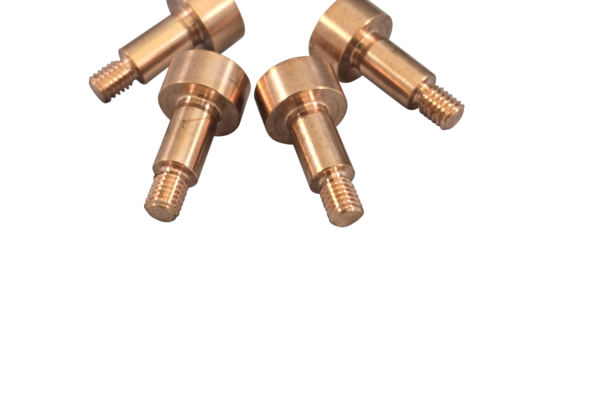

Answers to frequently asked questions
Copper-beryllium alloys are particularly resistant to wear and fatigue. This makes it ideal for applications with high friction or vibrating, dynamic loads. In its soft-annealed state, beryllium copper is easy to shape and can be worked relatively easily. The subsequent heat treatment at approx. 325 °C significantly increases the hardness and strength without becoming brittle or deforming. It can achieve a tensile strength of up to 1300 MPa, which is comparable to some steels.
Compared with brass, bronze and copper-nickel alloys, beryllium copper offers comparable corrosion resistance but significantly higher strength and hardness. Pure copper offers higher electrical and thermal conductivity, but its mechanical strength is significantly lower than that of beryllium copper.
Copper alloys have a high thermal conductivity – frictional heat is dissipated quickly so that no particles are heated to ignition temperature. In addition, the oxidation products are not flammable.
It is important to note that “non-sparking” does not technically mean “absolutely spark-free”. On the contrary, the risk of generating sparks capable of igniting a fire is greatly reduced. This is why standards and specialist circles often refer to low-spark or non-sparking materials.
The high corrosion resistance is ideal for applications in harsh environments, such as in the chemical industry, the offshore industry or in the aerospace industry.
The high electrical conductivity makes them interesting for electrical contacts and connectors.
The high resistance to wear and fatigue increases the service life of highly stressed components such as gears, bearing bushes, springs and switches.
The high thermal conductivity in combination with high strength is particularly interesting for toolmaking, plastic mold making, foundry technology or general mechanical engineering.
Yes, ALBROMET not only supplies semi-finished products in a wide range of dimensions and shapes, but also manufactures components from beryllium copper according to customer drawings. We have extensive experience in processing these alloys.
Beryllium is not a hazardous substance on the REACH candidate list (SVHC list). The lead content of ALBROMET copper alloys is minimal (< 0.1% by mass). This means that all low-alloy copper alloys comply with REACH and RoHS. You can find more information here.
Get in touch with us!
We will advise you competently and personally.


